


The Secret Journey of a Tablet

Updated: Sep 11
By Shreosee Ghosh, Scientific Officer SHRM Biotechnologies Pvt Ltd
How Quality Control Microbiology Protects Every Tablet You Take - Secret Journey
Whenever you pick up a strip of tablets from the pharmacy, you trust that the medicine inside will heal you, not make you sick. Most people imagine drug manufacturing as an exercise in mechanical precision; automated machines blending powders, stamping pills at lightning speed, and sealing them into shiny blister packs.
Yet chemistry and machinery tell only half the story. The greatest threat to modern medicine is entirely invisible to the naked eye: microbial contamination from bacteria, molds, and yeasts. Long before a tablet reaches your prescription bag, an elite team of scientists in cleanroom suits and sterile gloves works around the clock to ensure that no harmful organism enters the supply chain.

This vital discipline is Quality Control (QC) Microbiology. Below is the fascinating journey a simple tablet takes through the microbiology lab before it earns its place on the pharmacy shelf.
CORE PRINCIPLE: QC Microbiology is the frontline biological safeguard in pharma manufacturing; ensuring every oral solid dosage form is completely free from opportunistic pathogens, biofilm toxins, and microbial deterioration. |
Step 1: Testing the Ingredients Before Mixing Starts - To protect every pill we take
A finished pill is rarely pure medicine. In fact, the active pharmaceutical ingredient (API) often accounts for only a modest fraction of the tablet's weight. The remainder consists of inactive helpers called 'excipients'; plant-derived starches, natural sugars, and binding cellulose that give the pill its bulk, hold it together, and allow it to dissolve smoothly in your stomach.
Here is the biological challenge: microbes thrive on plant starches and sugars just as much as humans do. If an incoming shipment of raw excipient arrives harboring environmental mold spores or bacteria, blending it directly into the production cycle would ruin an entire production batch.
Before any ingredient is allowed into the factory blender, QC microbiologists test representative samples on specialized nutrient agar plates:
Total Aerobic Microbial Count (TAMC): Quantifying the background microbial count to ensure bio-burden stays safely below strict pharmacopeial thresholds.
Pathogen Screening: Testing specifically for zero-tolerance organisms such as Escherichia coli and Salmonella spp., which could cause severe gastrointestinal or systemic infections in compromised patients.
Pharmaceutical Water Loops: Sampling the facility's purified water ports daily. Because water is used in granulation and equipment sanitisation, it must be verified continuously to prevent biofilm formation.
Step 2: The Dangerous Window When Powders Get Wet - as a tablet makes its Journey
To press dry, flyaway powder into a firm, cohesive tablet, manufacturers use a process known as wet granulation. Active ingredients and excipients are sprayed with an aqueous binder solution to form small, dense granules; much like adding liquid to flour when preparing dough.
In the microbial world, water equals life. The combination of ambient manufacturing temperatures and free moisture can turn a batch of moist granules into an ideal breeding ground within hours.
QC microbiologists manage this risk by performing Hold-Time Validation Studies. They test wet granulated mass at predetermined intervals (e.g., 12, 24, 48, and 72 hours) to determine the exact microbiological safety window.
This validation establishes a strict, enforceable operational timer: factory operators know precisely how long they have to dry the granules in fluid bed dryers before bacteria have any chance to multiply.
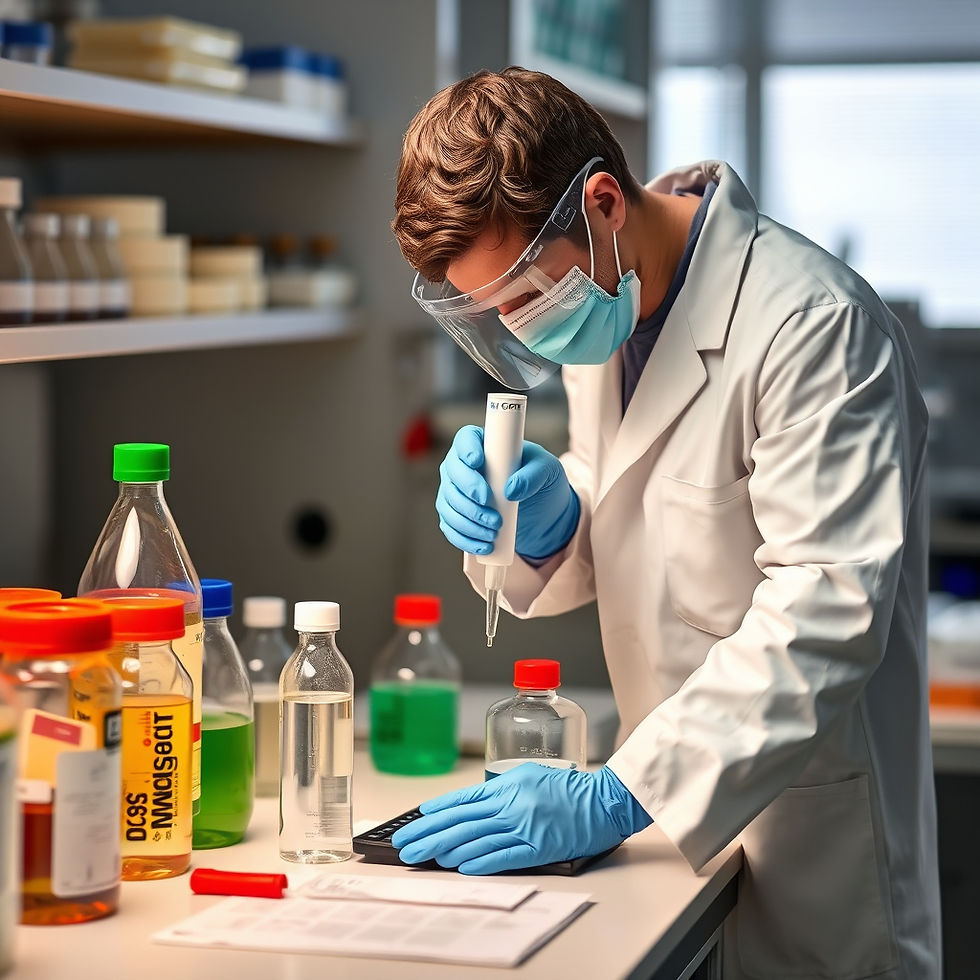
Step 3: Patrolling Cleanroom Air, Surfaces, and Personnel - Towards Secret Journey of a tablet
Once granules are dried, they are conveyed into high-speed rotary presses that punch out thousands of tablets per minute, followed by aqueous film coating to protect the tablet core and facilitate swallowing. These processes occur in environmentally controlled cleanroom suites.
Even though non-sterile tablets do not require the extreme isolation of injectable drugs, cleanroom air is continually filtered through High-Efficiency Particulate Air (HEPA) systems. Because humans naturally shed skin cells and microflora, QC microbiologists conduct active Environmental Monitoring (EM) throughout every production shift:
Active Volumetric Air Sampling: Calibrated air samplers draw measured volumes of cleanroom air across nutrient agar plates to capture suspended fungal spores and airborne bacteria.
Settle Plates: Open agar dishes are positioned near tablet press hoppers to monitor passive microbial fallout right where tablets are compressed.
Surface & Personnel Monitoring: Contact plates (RODAC) and sterile swabs are pressed against tablet tooling, conveyor belts, and operators' gloved fingers to ensure that physical touchpoints remain strictly compliant.
Step 4: The Three-Year Waiting Game (Stability & Water Activity) - Making secret journey of a tablet reach quality endpoint
Once the tablet is stamped, coated with a protective polymer, and sealed inside airtight blister foil, one crucial question remains: Will this pill still be completely safe if it sits in a warm, humid bathroom cabinet for two or three years?
To answer this, QC microbiologists subject sample batches to multi-year stability studies inside specialized climatic chambers simulating accelerated tropical heat and humidity:
Multi-Year Periodic Testing: At scheduled intervals (6, 12, 24, and 36 months), samples are dissolved and plated to prove that microbial quality does not deteriorate over time.
Water Activity (aw) Control: Microbiologists analyze the thermodynamic 'free water' in the tablet matrix. By maintaining water activity below critical thresholds (aw < 0.60), dormant spores are scientifically prevented from germinating, guaranteeing shelf stability.
Why QC Microbiology Is a Thriving Career for Bioscience Graduates
For students and professionals with backgrounds in Microbiology, Biotechnology, Biochemistry, or Life Sciences, understanding this journey reveals an essential truth about the industry: Quality Control Microbiology is fundamentally different from auditing or compliance paperwork.
Auditing is primarily retrospective. It involves reviewing documentation, batch manufacturing records, logbooks, and standard operating procedures to verify whether established protocols were followed in the past. It is an administrative and regulatory check.
QC Microbiology, by contrast, is live, frontline scientific detective work. When an unexpected bacterial colony appears on a settle plate or bio-burden counts drift upward, it is the bench microbiologist who leads the scientific investigation:
Root-Cause Investigations: Determining whether an alert stems from an air filtration anomaly, a cleaning failure, raw material degradation, or an operator growing lapse.
Rapid Identification: Employing advanced technology including MALDI-TOF Mass Spectrometry and PCR assays; to pinpoint the genus and species of the contaminant within hours.
Real-Time Release Authority: Making data-driven decisions that authorise or halt multi-million-dollar pharmaceutical batches.
INDUSTRY CAREER INSIGHT: The life sciences industry faces a clear talent need: plants require groomed bioscience professionals trained in aseptic protocols, pharmacopeial testing (USP/EP/IP), and cleanroom operations. Mastering these hands-on skills opens direct doors to roles such as QC Microbiologist, Bioburden Specialist, and Sterility Assurance Officer. |
Every safe tablet dispensed at a pharmacy is living proof of the expertise, precision, and vigilance of the QC microbiologists working behind the scenes. For bioscience graduates seeking a meaningful, high-demand career, QC microbiology transforms laboratory science into direct protection for millions of patients worldwide.
The opportunity is growing. The question is whether you are prepared to be industry-ready enough to take it.


Comments